I have been putting together this demo project for the BeagleBoneAI64. It is to be ultimate starting point for projects on this board.
Some of what is shown with this project:
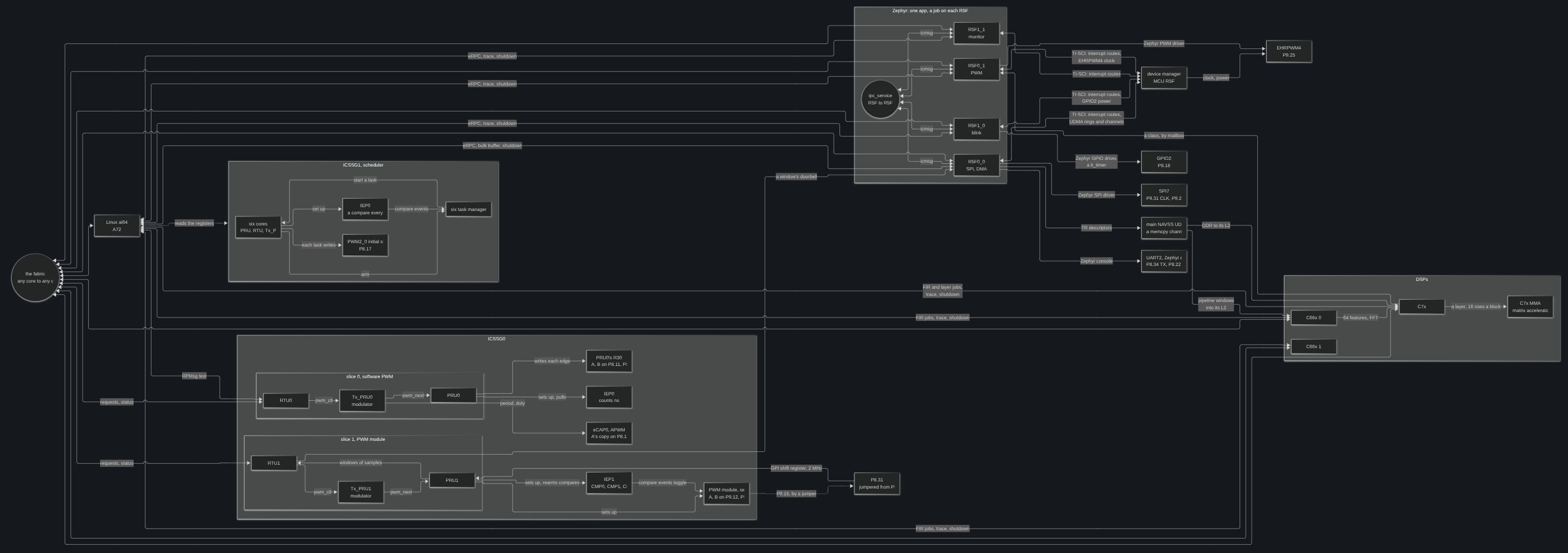
- Four R5Fs running Zephyr: one app, built with
west build --sysbuildinto four images. Each core has its own job (SPI7, PWM, a square wave, monitoring), and they talk to each other overipc_service. - Twelve ICSSG cores: ICSSG0 makes PWM three ways (software, the hardware PWM module, and eCAP), and its RTUs talk over RPMsg and the fabric. ICSSG1 runs TI’s multicore scheduler on all six cores, with tasks fired from IEP0.
- Three DSPs: the two C66x run FIR filters. The C7x runs FIR filters plus int8 neural-network layers on its MMA, fed by its Streaming Engines and DMA.
- A pipeline through five different cores: a PRU samples a header pin at 2 MHz, an R5F DMAs each window to a C66x for an FFT, the C7x’s MMA classifies the spectrum, and another R5F sets a PWM to match.
The cores talk to Linux and to each other over RPMsg, eRPC, and shared memory, including a “fabric” where any core can message any other directly. The project runs on BeagleBoard Debian with the v6.18-k3 kernel, there’s also a Yocto build option with TI’s 6.18 kernel.
Repo: BeagleBone AI-64 (TI TDA4VM / J721E) heterogeneous demo with examples on all 19 auxiliary main domain cores
My automation setup
To speed of development, I minimized my own physical involvement for this project. The LLM I was using had control over a power relay, a USB SD card mux, and a logic analyzer. With this setup, I did most of the development on this project from my cell phone. Many prompts were sent and directed from my bed, a parking lost, or at the grocery store. I would only need to come to the board for when the LLM asked me to move over logic analyzer pins.
Working on this project has been crazy. My work has turned from reading code, digging through TRMs, and carefully telling LLMs what to do, to ask, and it shows up.
