Okay so I got around to doing the final tests, and it seems like the problem lies with the TXB. This is a long post, but I wanted to be thorough and try a few extra setups just to make sure the TXB is the problem.
Just so I don’t state it with each example, the BBB was always on the B-side providing the 3.3V ref voltage for the TXB. VCC and common ground were established via the mini-breadboard’s power rails. WP# and HOLD# pins weren’t be connected. The Samsung NC110 mainboard has LEDs that indicate operation of individual components such as the GD25Q16, so I’ll be using that as an indicator of successful connection. The mainboard was removed from the case and all attached components etc. were removed, except for the CPU.
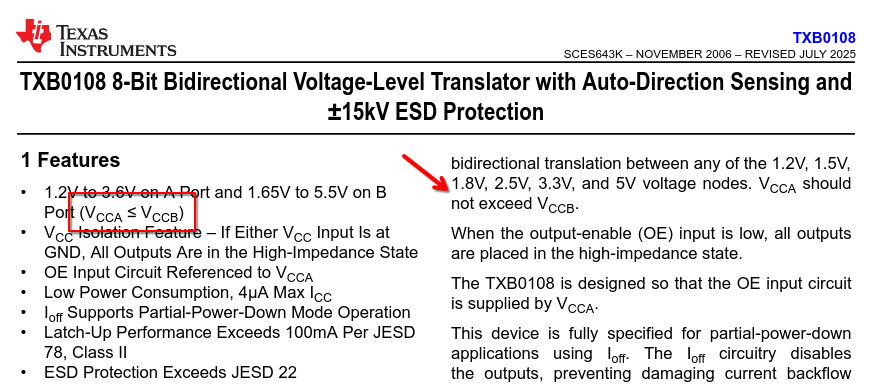
With the LM317 set to 2.7V hooked up to the TXB’s VCCA, flashrom’s probe did not detect the chip at all. The LED would flicker on then remain off when I attached the SOIC clip to the chip. It wasn’t a pin contact issue as I tried re-attaching the clip multiple times, while my attempts without the TXB worked first try each time. I don’t know if this indicates a current issue or something else; I tested the VCCA at various points in the circuit with my multimeter and it was always 2.7V. I tried 128 and 512kHz with the TXB.
With the LM317 output set to 2.8V, hooked up to the GD25Q16’s VCC, and the BBB hooked up to the I/O pins, I could perform a successful probe and read. LED stayed on throughout. The difference in operating voltage didn’t seem to matter.
With my PSU’s 3.3V output hooked to up the GD25Q16’s VCC, and the BBB hooked up to the I/O pins, I could perform a successful probe and read. LED stayed on throughout.
With the GD25Q16 hooked up directly to the BBB, I could perform a successful probe and read. LED stayed on throughout.
So I guess that’s it. The TXB0108 isn’t suited for SPI applications outside of a breadboard or similar short-range setup, most likely due to output drive, the auto-direction feature malfunctioning, or some other issue. I have a CH341A on the way which comes with a 1.8V adapter, so hopefully that will get the job done. The adapter might even work with the BBB if I’m lucky. If not, I’ll look into getting two 74LVCs or a TXS0108E. I’ll get that logic analyzer too.
Regarding the directional aspect of MOSI and MISO channels with uni-directional translators like the 74LVC: there’s a lot of conflicting info online, but since each SPI channel is uni-directional which facilitates bi-directional communication, I might be able to get away with a single 74LVC if I hook up the ROM chip’s MISO directly to my BBB and run everything else through a 74LVC (provided the BBB’s MISO will accept a 1.8V signal). A simple voltage divider might work with a low enough clock speed in a pinch but may not be good for data integrity. Threads I gathered this info from: One and two.
Thanks both of you for all the help! I learned a lot throughout this process and feel a lot more capable working with the BBB’s SPI and with ROM chips in general. Hopefully anyone else looking to learn more about these topics can use this thread to guide them. I’ll mark this as solved but may provide updates in the future.

 .
.